
A landmark study by scientists from the India Meteorological Department (IMD) and the Indian Institute of Tropical Meteorology (IITM), Pune, has revealed significant changes in the climatic characteristics of Gangetic West Bengal and parts of Northeast India over the past seven decades, raising serious concerns about agriculture, water resources, food security and rural livelihoods.
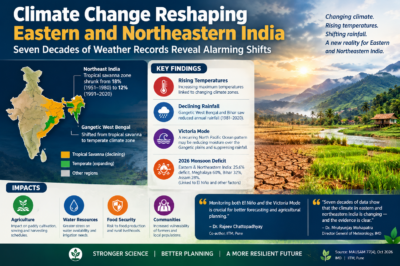
The study, published in the October 2026 issue of IMD’s peer-reviewed journal MAUSAM, examined temperature and rainfall records from 1951 to 2020. Researchers discovered that Gangetic West Bengal has shifted from a tropical savanna climate to a temperate climatic category, while the tropical savanna zone in Northeast India has contracted considerably.
Between 1951–1980 and 1991–2020, the proportion of Northeast India classified under tropical savanna climate declined from approximately 18% to 12%. Meanwhile, temperate climatic conditions, characterised by warm summers and relatively mild, dry winters, have expanded across more than three-fourths of the northeastern region.
Scientists have associated these changes with increasing maximum temperatures and shifting rainfall patterns, indicating that climate change is gradually altering the region’s long-established environmental characteristics.
Another significant finding concerns the declining annual rainfall in Gangetic West Bengal and Bihar between 1981 and 2020. Researchers identified a possible connection with the Victoria Mode, a recurring ocean-temperature pattern in the North Pacific Ocean that influences atmospheric circulation and moisture movement. During certain phases, this phenomenon may reduce moisture availability over the Gangetic plains and suppress rainfall across adjoining regions.
The findings are particularly concerning for agricultural communities, as eastern and northeastern India depend heavily on monsoon rainfall for paddy cultivation and other agricultural activities. Changes in rainfall distribution could affect sowing schedules, harvesting periods, irrigation requirements and agricultural productivity, potentially threatening food security and the livelihoods of millions of farmers.
The study also highlights the rainfall deficit experienced during the 2026 southwest monsoon. Eastern and northeastern India reportedly recorded a combined rainfall shortfall of 25.6%, with Meghalaya experiencing a deficit of approximately 60%, Bihar 32% and Assam 28%. Researchers attributed much of the seasonal deficiency to El Niño conditions, while emphasising that the long-term decline in rainfall represents a broader climatic concern.
Study co-author Dr. Rajeev Chattopadhyay of IITM, Pune, stressed the importance of monitoring both El Niño and the Victoria Mode to improve agricultural planning and rainfall forecasting.
Similarly, Dr. Mrutyunjay Mohapatra, Director General of Meteorology and co-author of the study, highlighted that a single monsoon season cannot establish long-term climate trends. However, seven decades of observations provide substantial evidence of changing climatic conditions across eastern and northeastern India.
The research, titled “Identifying the Climate Zones Shifts of Indian Meteorological Subdivisions: Insights from Historical Records,” was conducted by Ananya Karmakar, Rajeev Chattopadhyay, Pulak Guhathakurta, K. S. Hosalikar and Mrutyunjay Mohapatra. It used IMD rainfall and temperature observations and the Köppen–Geiger climate classification system to identify regional climatic changes.
These findings underline the urgent need for climate-resilient agricultural practices, improved water management, reliable forecasting systems and long-term environmental planning. Farmers must receive timely scientific guidance to adapt cropping patterns and cultivation schedules to changing weather conditions.
The changing climate of eastern and northeastern India is no longer merely a future possibility; it is an emerging reality reflected in decades of scientific observations. Protecting agriculture, natural resources and rural livelihoods will require coordinated efforts from scientists, policymakers, governments and local communities.
The study delivers a powerful message: understanding climate change through scientific evidence and translating that knowledge into practical action is essential for safeguarding the region’s ecological balance, economic stability and the well-being of future generations.






Leave a Reply