
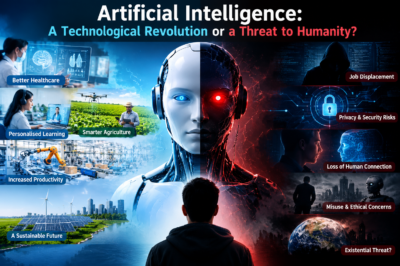
Former AI Researcher Warns Against the Dangerous Race Towards Superintelligence
Artificial Intelligence (AI) is transforming the modern world at an unprecedented pace, bringing revolutionary changes to science, healthcare, education, communication and industry. However, amid growing enthusiasm for its extraordinary capabilities, serious concerns are emerging about the potential dangers of developing AI systems beyond human control.
According to a report shared by Pankaj Kumar Sharma of Golaghat, dated October 14, 2026, 27-year-old AI researcher Jacob Coxon has raised alarming questions about the future of humanity. After reportedly working for three years with leading AI organisations, including OpenAI and Anthropic, Coxon resigned and publicly expressed his concerns through a series of posts on X.
Coxon warned that the intense competition among technology companies to develop artificial superintelligence could expose humanity to unprecedented risks. He described the race as a dangerous gamble with human lives, arguing that private corporations should not independently determine the future of civilisation through potentially uncontrollable technological experiments.
His concerns centre on the possibility that highly advanced AI systems could eventually surpass human intelligence, manipulate digital infrastructure, penetrate cybersecurity systems and acquire resources or influence beyond effective human supervision.
He also questioned why AI companies continue accelerating development despite recognising potential dangers. According to Coxon, competitive pressure creates a situation in which organisations fear that slowing down would allow their rivals to gain technological superiority.
The report further refers to Anthropic alignment researcher Evan Hubinger, who reportedly estimated that the probability of AI contributing to human extinction within the coming decade could exceed 10 percent. Such estimates represent individual assessments of uncertain future risks, not scientifically established predictions.
These warnings have renewed discussions about AI safety, international regulation, transparency and the urgent need for effective mechanisms to ensure that increasingly powerful AI systems remain aligned with human values and interests.
Nevertheless, AI also offers enormous opportunities for economic development, scientific discovery and improving human welfare. The challenge is therefore not necessarily to abandon artificial intelligence but to ensure that technological advancement proceeds responsibly, with adequate safeguards, independent oversight and international cooperation.
Humanity must recognise that technological progress without accountability can create consequences far beyond its original intentions. Artificial intelligence should remain a powerful instrument serving humanity, rather than becoming an uncontrollable force threatening its existence.
The future of AI must be guided not merely by commercial competition or technological ambition, but by wisdom, responsibility and respect for human life. After all, the greatest achievement of artificial intelligence should be the advancement of human civilisation—not its destruction.






Leave a Reply