
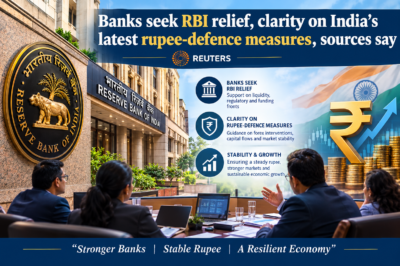
India’s foreign exchange market is experiencing a period of uncertainty as the Indian rupee faces persistent pressure from a strong US dollar and fluctuations in global financial markets. Amid these challenges, the Reserve Bank of India (RBI) has reportedly intensified its efforts to contain excessive currency volatility, prompting several commercial banks to seek clearer guidance on the central bank’s regulatory measures, particularly those affecting offshore Non-Deliverable Forward (NDF) markets.
The RBI’s approach reportedly involves interventions in the spot and forward markets, alongside measures to discourage speculative trading and arbitrage between domestic and offshore rupee markets. Although these steps are intended to protect the currency from sharp depreciation and destabilising market movements, banks have expressed concerns about the uncertainty created by restrictions communicated through informal channels.
Commercial lenders argue that the absence of clearly documented guidelines makes it difficult to interpret regulatory expectations and maintain consistent compliance. They must simultaneously manage liquidity, control financial risks and meet the foreign exchange requirements of their customers. Restrictions on offshore market activities may also make hedging more expensive, reduce market liquidity and widen the gap between buying and selling rates, potentially increasing costs for Indian importers and exporters.
The issue extends beyond the immediate management of the rupee. India has been seeking to strengthen its position in international finance by developing Gujarat International Finance Tec-City (GIFT City) as a major financial hub. However, uncertainty surrounding foreign exchange regulations could complicate efforts to attract international banks and encourage greater rupee trading within India.
The RBI, meanwhile, faces a complex economic challenge. A weaker rupee can raise the cost of imported goods, particularly crude oil, thereby contributing to inflationary pressures. At the same time, global interest-rate trends, geopolitical uncertainties and movements of international capital continue to influence emerging-market currencies, including the rupee. The central bank must therefore balance currency stability with the need to preserve an efficient and competitive financial market.
Banks’ demand for regulatory clarity should consequently be viewed as a call for better coordination rather than opposition to the RBI’s objectives. A transparent and predictable framework could help lenders distinguish legitimate hedging and market-making activities from excessive speculative positions.
Ultimately, sustainable currency stability depends not only on central bank intervention but also on strong market fundamentals, adequate liquidity and investor confidence. Clear communication between the RBI and commercial banks would help reduce uncertainty, improve market functioning and reinforce the resilience of India’s financial system amid continuing global economic volatility.







Leave a Reply